Add Native Code
We are going to add native code in cpp folder.
- Right click on
cppfolder New -> C++ class. Give it a nameglesjni. and press OK. You will see two files created on your computerglesjni.handglesjni.cpp.
Add following content to glesjni.h in between the tags as below
#ifndef GDGFESTGLES3_GLESJNI_H
#define GDGFESTGLES3_GLESJNI_H 1

// PASTE BELOW Code here HERE


#endif //GDGFESTGLES3_GLESJNI_H
#include <android/log.h>
#include <math.h>


#include <GLES3/gl3.h>

#define DEBUG 1

#define LOG_TAG "GLESJNI"
#define ALOGE(...) __android_log_print(ANDROID_LOG_ERROR, LOG_TAG, __VA_ARGS__)
#if DEBUG
#define ALOGV(...) __android_log_print(ANDROID_LOG_VERBOSE, LOG_TAG, __VA_ARGS__)
#else
#define ALOGV(...)
#endif

// ----------------------------------------------------------------------------
// Types, functions, and data used by both ES2 and ES3 renderers.
// Defined in gles3jni.cpp.

#define MAX_INSTANCES_PER_SIDE 16
#define MAX_INSTANCES   (MAX_INSTANCES_PER_SIDE * MAX_INSTANCES_PER_SIDE)
#define TWO_PI          (2.0 * M_PI)
#define MAX_ROT_SPEED   (0.3 * TWO_PI)

// This demo uses three coordinate spaces:
// - The model (a quad) is in a [-1 .. 1]^2 space
// - Scene space is either
//    landscape: [-1 .. 1] x [-1/(2*w/h) .. 1/(2*w/h)]
//    portrait:  [-1/(2*h/w) .. 1/(2*h/w)] x [-1 .. 1]
// - Clip space in OpenGL is [-1 .. 1]^2
//
// Conceptually, the quads are rotated in model space, then scaled (uniformly)
// and translated to place them in scene space. Scene space is then
// non-uniformly scaled to clip space. In practice the transforms are combined
// so vertices go directly from model to clip space.

struct Vertex {
    GLfloat pos[2];
    GLubyte rgba[4];
};
extern const Vertex QUAD[4];

// returns true if a GL error occurred
extern bool checkGlError(const char* funcName);
extern GLuint createShader(GLenum shaderType, const char* src);
extern GLuint createProgram(const char* vtxSrc, const char* fragSrc);

// ----------------------------------------------------------------------------
// Interface to the ES2 and ES3 renderers, used by JNI code.

class Renderer {
public:
    virtual ~Renderer();
    void resize(int w, int h);
    void render();

protected:
    Renderer();

    // return a pointer to a buffer of MAX_INSTANCES * sizeof(vec2).
    // the buffer is filled with per-instance offsets, then unmapped.
    virtual float* mapOffsetBuf() = 0;
    virtual void unmapOffsetBuf() = 0;
    // return a pointer to a buffer of MAX_INSTANCES * sizeof(vec4).
    // the buffer is filled with per-instance scale and rotation transforms.
    virtual float* mapTransformBuf() = 0;
    virtual void unmapTransformBuf() = 0;

    virtual void draw(unsigned int numInstances) = 0;

private:
    void calcSceneParams(unsigned int w, unsigned int h, float* offsets);
    void step();

    unsigned int mNumInstances;
    float mScale[2];
    float mAngularVelocity[MAX_INSTANCES];
    uint64_t mLastFrameNs;
    float mAngles[MAX_INSTANCES];
};

extern Renderer* createES2Renderer();
Copy the following code in glesjni.cpp
/*
 * Copyright 2013 The Android Open Source Project
 *
 * Licensed under the Apache License, Version 2.0 (the "License");
 * you may not use this file except in compliance with the License.
 * You may obtain a copy of the License at
 *
 *      http://www.apache.org/licenses/LICENSE-2.0
 *
 * Unless required by applicable law or agreed to in writing, software
 * distributed under the License is distributed on an "AS IS" BASIS,
 * WITHOUT WARRANTIES OR CONDITIONS OF ANY KIND, either express or implied.
 * See the License for the specific language governing permissions and
 * limitations under the License.
 */

#include <jni.h>
#include <stdlib.h>
#include <time.h>

#include "glesjni.h"

const Vertex QUAD[4] = {
        // Square with diagonal < 2 so that it fits in a [-1 .. 1]^2 square
        // regardless of rotation.
        {{-0.7f, -0.7f}, {0x00, 0xFF, 0x00}},
        {{ 0.7f, -0.7f}, {0x00, 0x00, 0xFF}},
        {{-0.7f,  0.7f}, {0xFF, 0x00, 0x00}},
        {{ 0.7f,  0.7f}, {0xFF, 0xFF, 0xFF}},
};

bool checkGlError(const char* funcName) {
    GLint err = glGetError();
    if (err != GL_NO_ERROR) {
        ALOGE("GL error after %s(): 0x%08x\n", funcName, err);
        return true;
    }
    return false;
}

GLuint createShader(GLenum shaderType, const char* src) {
    GLuint shader = glCreateShader(shaderType);
    if (!shader) {
        checkGlError("glCreateShader");
        return 0;
    }
    glShaderSource(shader, 1, &src, NULL);

    GLint compiled = GL_FALSE;
    glCompileShader(shader);
    glGetShaderiv(shader, GL_COMPILE_STATUS, &compiled);
    if (!compiled) {
        GLint infoLogLen = 0;
        glGetShaderiv(shader, GL_INFO_LOG_LENGTH, &infoLogLen);
        if (infoLogLen > 0) {
            GLchar* infoLog = (GLchar*)malloc(infoLogLen);
            if (infoLog) {
                glGetShaderInfoLog(shader, infoLogLen, NULL, infoLog);
                ALOGE("Could not compile %s shader:\n%s\n",
                      shaderType == GL_VERTEX_SHADER ? "vertex" : "fragment",
                      infoLog);
                free(infoLog);
            }
        }
        glDeleteShader(shader);
        return 0;
    }

    return shader;
}

GLuint createProgram(const char* vtxSrc, const char* fragSrc) {
    GLuint vtxShader = 0;
    GLuint fragShader = 0;
    GLuint program = 0;
    GLint linked = GL_FALSE;

    vtxShader = createShader(GL_VERTEX_SHADER, vtxSrc);
    if (!vtxShader)
        goto exit;

    fragShader = createShader(GL_FRAGMENT_SHADER, fragSrc);
    if (!fragShader)
        goto exit;

    program = glCreateProgram();
    if (!program) {
        checkGlError("glCreateProgram");
        goto exit;
    }
    glAttachShader(program, vtxShader);
    glAttachShader(program, fragShader);

    glLinkProgram(program);
    glGetProgramiv(program, GL_LINK_STATUS, &linked);
    if (!linked) {
        ALOGE("Could not link program");
        GLint infoLogLen = 0;
        glGetProgramiv(program, GL_INFO_LOG_LENGTH, &infoLogLen);
        if (infoLogLen) {
            GLchar* infoLog = (GLchar*)malloc(infoLogLen);
            if (infoLog) {
                glGetProgramInfoLog(program, infoLogLen, NULL, infoLog);
                ALOGE("Could not link program:\n%s\n", infoLog);
                free(infoLog);
            }
        }
        glDeleteProgram(program);
        program = 0;
    }

    exit:
    glDeleteShader(vtxShader);
    glDeleteShader(fragShader);
    return program;
}

static void printGlString(const char* name, GLenum s) {
    const char* v = (const char*)glGetString(s);
    ALOGV("GL %s: %s\n", name, v);
}

// ----------------------------------------------------------------------------

Renderer::Renderer()
        :   mNumInstances(0),
            mLastFrameNs(0)
{
    memset(mScale, 0, sizeof(mScale));
    memset(mAngularVelocity, 0, sizeof(mAngularVelocity));
    memset(mAngles, 0, sizeof(mAngles));
}

Renderer::~Renderer() {
}

void Renderer::resize(int w, int h) {
    auto offsets = mapOffsetBuf();
    calcSceneParams(w, h, offsets);
    unmapOffsetBuf();

    // Auto gives a signed int :-(
    for (auto i = (unsigned)0; i < mNumInstances; i++) {
        mAngles[i] = drand48() * TWO_PI;
        mAngularVelocity[i] = MAX_ROT_SPEED * (2.0*drand48() - 1.0);
    }

    mLastFrameNs = 0;

    glViewport(0, 0, w, h);
}

void Renderer::calcSceneParams(unsigned int w, unsigned int h,
                               float* offsets) {
    // number of cells along the larger screen dimension
    const float NCELLS_MAJOR = MAX_INSTANCES_PER_SIDE;
    // cell size in scene space
    const float CELL_SIZE = 2.0f / NCELLS_MAJOR;

    // Calculations are done in "landscape", i.e. assuming dim[0] >= dim[1].
    // Only at the end are values put in the opposite order if h > w.
    const float dim[2] = {fmaxf(w,h), fminf(w,h)};
    const float aspect[2] = {dim[0] / dim[1], dim[1] / dim[0]};
    const float scene2clip[2] = {1.0f, aspect[0]};
    const int ncells[2] = {
            static_cast<int>(NCELLS_MAJOR),
            (int)floorf(NCELLS_MAJOR * aspect[1])
    };

    float centers[2][MAX_INSTANCES_PER_SIDE];
    for (int d = 0; d < 2; d++) {
        auto offset = -ncells[d] / NCELLS_MAJOR; // -1.0 for d=0
        for (auto i = 0; i < ncells[d]; i++) {
            centers[d][i] = scene2clip[d] * (CELL_SIZE*(i + 0.5f) + offset);
        }
    }

    int major = w >= h ? 0 : 1;
    int minor = w >= h ? 1 : 0;
    // outer product of centers[0] and centers[1]
    for (int i = 0; i < ncells[0]; i++) {
        for (int j = 0; j < ncells[1]; j++) {
            int idx = i*ncells[1] + j;
            offsets[2*idx + major] = centers[0][i];
            offsets[2*idx + minor] = centers[1][j];
        }
    }

    mNumInstances = ncells[0] * ncells[1];
    mScale[major] = 0.5f * CELL_SIZE * scene2clip[0];
    mScale[minor] = 0.5f * CELL_SIZE * scene2clip[1];
}

void Renderer::step() {
    timespec now;
    clock_gettime(CLOCK_MONOTONIC, &now);
    auto nowNs = now.tv_sec*1000000000ull + now.tv_nsec;

    if (mLastFrameNs > 0) {
        float dt = float(nowNs - mLastFrameNs) * 0.000000001f;

        for (unsigned int i = 0; i < mNumInstances; i++) {
            mAngles[i] += mAngularVelocity[i] * dt;
            if (mAngles[i] >= TWO_PI) {
                mAngles[i] -= TWO_PI;
            } else if (mAngles[i] <= -TWO_PI) {
                mAngles[i] += TWO_PI;
            }
        }

        float* transforms = mapTransformBuf();
        for (unsigned int i = 0; i < mNumInstances; i++) {
            float s = sinf(mAngles[i]);
            float c = cosf(mAngles[i]);
            transforms[4*i + 0] =  c * mScale[0];
            transforms[4*i + 1] =  s * mScale[1];
            transforms[4*i + 2] = -s * mScale[0];
            transforms[4*i + 3] =  c * mScale[1];
        }
        unmapTransformBuf();
    }

    mLastFrameNs = nowNs;
}

void Renderer::render() {
    step();

    glClearColor(0.2f, 0.2f, 0.3f, 1.0f);
    glClear(GL_COLOR_BUFFER_BIT | GL_DEPTH_BUFFER_BIT);
    draw(mNumInstances);
    checkGlError("Renderer::render");
}

// ----------------------------------------------------------------------------

static Renderer* g_renderer = NULL;
At this point, if you won't see glesjni.h and glesjni.cpp file in cpp folder. It is because we haven't added it in our CMake script. Let's do it now. Add following line in CMakeLists.txt file below src/main/cpp/native-lib.cpp.
src/main/cpp/glesjni.cpp
so that your add_library looks like following
add_library( # Sets the name of the library.
             native-lib

             # Sets the library as a shared library.
             SHARED

             # Provides a relative path to your source file(s).
             # Associated headers in the same location as their source
             # file are automatically included.
             src/main/cpp/native-lib.cpp
             src/main/cpp/glesjni.cpp)
- Next, we are going to add JNI methods. Android studio provides a convenient way to add it automatically form Java code.
Create a new file GLESJNILib in same directory as gdgfestgles3 and add following code.
public class GLESJNILib {

    static  {

        System.loadLibrary(" native-lib");
    }

    public static native void init();
    public static native void resize(int width, int height);
    public static native void step();
}
Wait for context aware menu prompt to appear. Click on to open popupmenu.
Select Create Function Java_..._init() function.
Android Studio creates a prototype function for init() in glesjni.cpp file under the "cpp" folder.
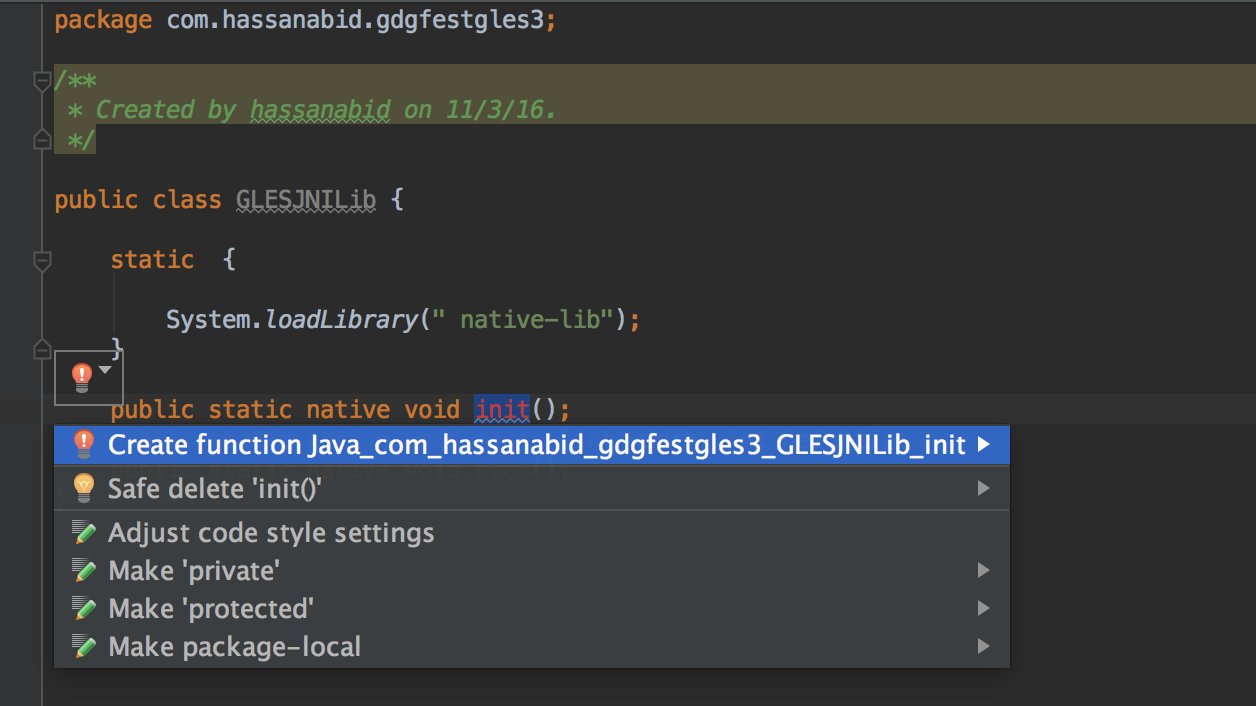
Repeat the above process for resize and step function.
After we are done, we will see the following three functions in glesjni.cpp
JNIEXPORT void JNICALL
Java_com_hassanabid_gdgfestgles3_GLESJNILib_init(JNIEnv *env, jclass type) {

    // TODO

}

JNIEXPORT void JNICALL
Java_com_hassanabid_gdgfestgles3_GLESJNILib_resize(JNIEnv *env, jclass type, jint width,
                                                   jint height) {

    // TODO

}

JNIEXPORT void JNICALL
Java_com_hassanabid_gdgfestgles3_GLESJNILib_step(JNIEnv *env, jclass type) {

    // TODO

}
- We have to declare above three JNI methods with extern "C" keyword so that can be used elsewhere if we provide
libnative-lib.sofile.
Add following code above JNI methods in glesjni.cpp
extern "C" {
JNIEXPORT void JNICALL Java_com_hassanabid_gdgfestgles3_GLESJNILib_init(JNIEnv* env, jclass type);
JNIEXPORT void JNICALL Java_com_hassanabid_gdgfestgles3_GLESJNILib_resize(JNIEnv* env, jclass type, jint width, jint height);
JNIEXPORT void JNICALL Java_com_hassanabid_gdgfestgles3_GLESJNILib_step(JNIEnv* env, jclass type);
};
Make sure to change package name
com_hassanabid_gdgfestgles3in the above methods to your own.
Sync  , Build
  , there should be some
 errors from Android Studio. Let's fix them in next chapter.